
Ambush Marketing: How Brands Win Attention Without Official Sponsorship


Ambush marketing is one of the most creative and controversial strategies in major sports events. It happens when a brand finds a way to connect itself with the public excitement around a tournament without being an official sponsor.
For non-expert audiences, the idea is simple: one company pays for official rights, while another company tries to capture attention around the same cultural moment through creativity, timing, humor, or association.
In global football tournaments, this strategy becomes especially visible because official sponsorship rules are strict. Brands cannot freely use protected names, logos, trophies, stadium marks, or tournament phrases. That limitation often forces them to be more inventive.
Ambush Marketing and the Power of What Is Missing
One of the strongest tools in ambush marketing is negative space. When a brand cannot show its name, the absence itself can become the message. If the public already knows the shape, colors, lighting, or location of a brand, covering the logo may make people notice it even more.
This often happens with stadium naming rights. A brand may own the name of a stadium, but if it is not an official sponsor of the international federation or tournament, its logo can be covered during the event. On paper, the brand disappears. In practice, the public may still recognize the building.
The result can feel like visual censorship. People see the covered letters, identify what is missing, and talk about it. The human brain completes familiar patterns, so the covered sign can become more memorable than the original sign. The brand benefits because the act of hiding it becomes a story.
Language Games and Legal Creativity
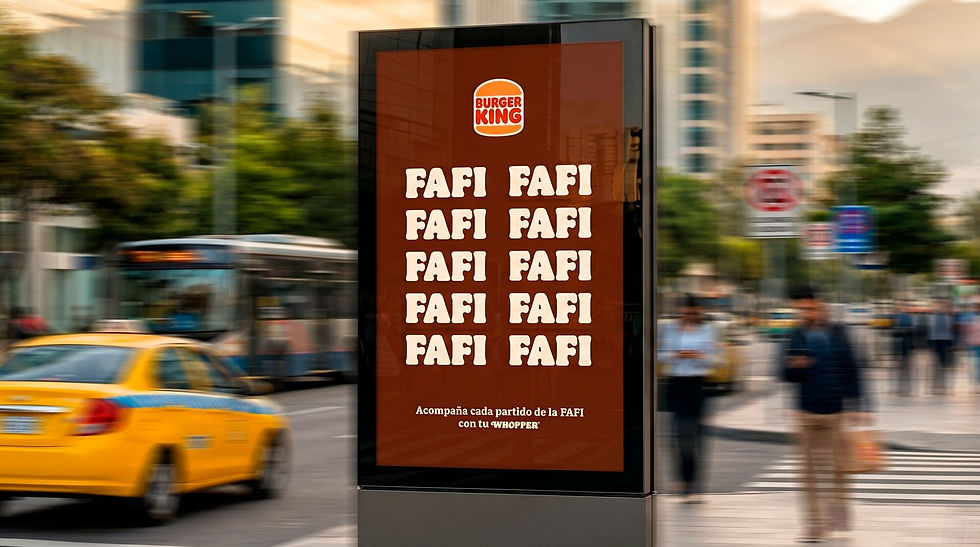
Another common form of ambush marketing is linguistic creativity. If a brand cannot say the official tournament name, it can use alternative phrases, playful wording, anagrams, or indirect references. The goal is to make the audience understand the reference without crossing legal boundaries.
Food brands have often used this approach. A snack company might talk about a “crunchy cup,” decorate packaging with national colors, or arrange products in supermarket displays that clearly suggest football competition. The campaign does not need to show the protected trophy or official logo for people to understand the context.
Retailers and technology companies also use broad phrases such as “the big tournament,” “the month when the world stops,” or “ready for the summer of football.” These expressions are not usually protected trademarks. They work because they connect with a shared cultural truth: millions of people organize their routines around the matches.
The Athlete Instead of the Event
Some of the most effective campaigns avoid the tournament completely and focus on players. This is a powerful route because athletes are part of the event’s visual culture, even when they are outside official venues.
A famous example came in 2014, when Beats gave customized headphones in national colors to high-profile footballers before the tournament. Sony was an official sponsor in the audio and technology category, which gave it strong visibility inside official spaces. Beats, however, found attention in the moments around the event.
Players were filmed arriving at airports, leaving buses, and moving through public spaces while wearing the headphones. Cameras captured these informal scenes constantly. The official sponsor had the stadium environment, but Beats gained repeated exposure through athlete lifestyle imagery. That is the central logic of ambush marketing: the culture around the event can be as valuable as the event itself.
Local Culture, Fans, and the Sponsor-Free Route
Brands can also build campaigns around fans rather than official tournament symbols. This makes the message feel broader, warmer, and less dependent on protected intellectual property. It also gives companies room to celebrate the event atmosphere without pretending to be official partners.
Lufthansa’s “Fanhansa” campaign is a strong example. The airline temporarily changed the name painted on some aircraft to celebrate fans. It did not need to use the official tournament logo, trophy, or protected phrases. The visual impact came from aircraft appearing in airports with a name that immediately connected travel, football, and national enthusiasm.
This kind of strategy works because major tournaments are not only sporting competitions. They are also travel moments, family moments, media moments, and local culture moments. A brand can enter the conversation by supporting the experience around the tournament instead of directly referencing the tournament brand.

Nike and the Art of Owning the Conversation
Nike has become one of the most recognized names in ambush marketing because it often competes with official sponsors through storytelling. While Adidas has frequently held major official football rights, including tournament balls and sponsorship packages, Nike has often invested in athletes, teams, films, and cultural moments.
Campaigns such as “Write the Future” and “The Airport” became famous because they treated football like cinema. They used star players, dramatic scenarios, comedy, pressure, and imagination to create content people wanted to watch and share.
The key is that the tournament does not need to be named. If the best players in the world appear in a football film released just before a global competition, the audience understands the connection. The brand owns the emotional buildup without needing to display official tournament marks.
Why Ambush Marketing Stays Memorable
The most effective ambush marketing campaigns are not random tricks. They work because they understand how audiences think. Fans are not only watching official ads. They are watching airports, social media, press conferences, supermarkets, street culture, and athlete behavior.
This gives non-sponsor brands many possible entry points. They can use humor, timing, design, language, packaging, influencers, or cultural rituals. When done carefully, the campaign feels clever rather than misleading.
The risk is that brands must stay within legal and ethical boundaries. They should not falsely claim official sponsorship or use protected assets without permission. The strongest campaigns usually succeed because they suggest, not because they copy. They invite the audience to make the connection.
In the end, ambush marketing shows that attention is not always bought through official access. Sometimes it is earned through sharper cultural timing. The public often rewards boldness, especially when a campaign understands the event’s mood better than a standard corporate advertisement.


Comments